
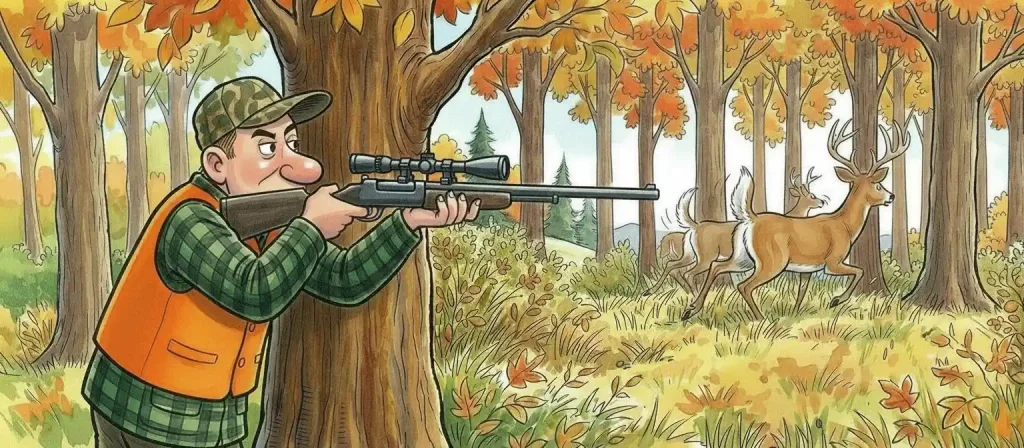
Whitetail Deer Travel Corridors: How to Find and Hunt the Best Deer Movement Routes
Find the Funnels, Find the Deer
It was learning that deer don’t roam haphazardly across landscapes which was one of my greatest breakthroughs in deer hunting. Migration patterns are well-established as the animals move with purpose, crossing land to reach known bedding grounds, feeding sources, and breeding areas in a predictable sequence. When I grasped the concept of whitetail deer travel corridors, my tree stand placements became more effective, I saw more deer, and my hunting became much more predictable. Understanding whitetail deer travel corridors is crucial for any serious hunter.
Whitetail deer use established pathways when they move throughout their territory. The choice of route depends on terrain, cover, security and efficiency considerations. By knowing where the main deer travel corridors are, you’ll be in a position where you don’t have to wait for deer to wander by, but instead set up where they’re most likely to pass through. It’s often a guess, but an educated guess.😉
When considering whitetail deer hunting strategies, it is worthwhile to consider travel routes that the animals use. These paths, or deer travel corridors, are areas frequently used by deer to get to their destinations. Below are a few tips on how to locate them as well as some ideas on hunting these routes.
What Are Whitetail Deer Travel Corridors?
Consistently, deer take certain routes when moving from important sites such as their bedding and feeding grounds. Deer will establish certain routes that they use in order to traverse the countryside while trying to avoid any threats.
Whitetail deer travel corridors allow whitetails to move from bedding to feeding and back again. Deer will often travel along features of the terrain, such as along the tops of ridges, the edges of benches, creek beds, fences, the edges of wooded areas and transitions from one type of habitat to another. Habitual usage by deer over the years renders such routes easily detectable, provided one knows what to look for.
In my experience the best routes from bedding to feeding are not always the most obvious.
Whitetail Deer Travel Routes Between Bedding and Food
Travel corridors of deer can be located by observing the patterns of deer movement between bedding areas and feeding areas. White-tailed deer generally lie down to rest in sheltered spots which provide them with protection, also give them a prevailing wind, and enable them to keep an eye out for any potential threats – basically, the wind blowing at their backs while they position themselves to they can see the downwind side.
Most routes that deer take do not involve a direct line from one place to another. Wild deer usually make use of dense woods and undergrowth to traverse through areas while avoiding open spaces. They do this to check out any danger that may be ahead of them and to conceal themselves from view. This is particularly true of older deer. These travel routes are usually referred to as funnels – which can be formed by terrain or vegetation.
In identifying where deer will be, I focus on trails that connect key bedding areas to primary food sources including mast-bearing timber, agricultural fields, food plots and the woodland edges with an abundance of food or browse. Look for signs of deer scat, rubs, scrapes and trails.
When you are aware of the normal daily movements of the deer you will be able to position your stand so that you are in a position to hunt the deer at their most natural points of travel (funnels) rather than forcing them to move by using bait or pressure.
How to Find Whitetail Deer Travel Corridors
When it comes to locating white-tailed deer, it’s necessary to learn how to identify their travel routes by reading the lay of the land. Deer may also be funneled by the topography of the landscape.
I concentrate my hunting at times and locations where white-tailed deer naturally have to move in a congested area, once again – a funnel. Look for a funnel to ambush deer in. A funnel might be strips of timber separated by open areas, saddles on ridges, and the inside corner where woods meet open fields. One of my favorite funnels to hunt was an inside corner of the woods that the deer crossed to go out into an alfalfa field.
One can use topographic maps and aerial photographs to locate potential routes before ever venturing into the field. Now, I rarely consult a map, at least a paper one. I now use Google Earth and a software app on my phone called onX Hunt to do my visual scouting.
Getting your “boots on the ground” will help you find travel corridors that are used frequently and will show signs of repeated animal usage, such as wear on vegetation and the presence of animal tracks. The tracks are not limited to any one animal, but are rather a combination of the tracks of various animals.
When exploring any area, the essential factor is in combining visuals (maps or mapping software) with field reconnaissance to figure out where deer might be traveling.
Natural Travel Corridors for Mature Bucks
Older bucks have different travel patterns than younger deer which means hunters should adjust their strategy. Mature deer are generally more concerned with evading potential threats than younger deer. In order to accomplish this, they will often travel different routes.
In my own experience, white-tailed deer will usually stick to travel routes which provide them with cover and let them take advantage of the wind. Mature deer will at times, make use of alternative paths that run in tandem with the well-trodden routes.
When bucks are in their pre-rutting or rutting phase, they usually move into doe bedding areas, doing so along established paths or routes. Bucks will also scent-check a doe bedding area from downwind.
Knowing how whitetail deer make use of their travel routes is crucial in order to increase your odds of a successful season.
Whitetail Deer Movement Through Funnels and Pinch Points
One of the whitetail deer’s primary pathways is a funnel which directs their movement. In a funnel, deer movement is usually channelled through a specific place due to the presence of terrain features, cover or other forms of obstacles.
The majority of deer funnels are found at creek crossings, where woods meet open fields and at fence gaps. Others are at ridge saddles, narrow strips of timber and inside field corners. In areas where a few travel routes intersect, the paths of deer can be anticipated with some certainty.
While hunting in a funnel can be very effective, hunting downwind of it slightly can be your best bet. It ensures that deer may use the route without being alarmed by human odor.
Common Mistakes When Hunting Deer Travel Corridors
Don’t set up game cameras in view of the most heavily used trails, but if you do, make sure to place them above a deer’s line of sight.
Failing to take into consideration the wind direction. A great travel corridor can be ruined if you hunt the wrong wind.
Overhunting is another issue. Whitetail deer adapt to the conditions of their environment including high pressure and will alter their path if the route they were following becomes over-hunted. Stand rotation together with hunting only under ideal conditions keeps the corridors more productive and will give you a greater chance of hunting success.
Best Places to Hunt Deer Travel Corridors
Whitetail deer travel corridors, which are often found at the edges of forests, are prime locations for deer. They allow the animals to move through areas of dense woodland in search of food and water. Travel corridors are created when deer are forced into a smaller area by terrain and/or vegetation. These travel corridors are known as “pinch points” as well as “funnels”. Identify routes which connect food and deer bedding areas and that allow passage through a narrow area while providing concealment.
It is often recommended to position a stand on the downwind side of the deer trail, but inside of the protective cover, so the deer feel free to move about normally. Entry and exit routes matter just as much as stand location.
The timing of a hunt can be very crucial. Early morning hunting can be the most successful when hunting the trails that lead back from a feeding area to a deer bedding area. Late afternoon hunting is typically more successful when hunting the trails that lead to feeding areas from bedding areas.
Frequently Asked Questions About Whitetail Deer Travel Corridors
Conclusion
Hunting whitetail deer based on the animal’s daily patterns has drastically changed my hunting techniques. In the woods, hunters tend to guess where deer might show up, but a more productive approach is to consider where deer wish to roam. By observing these pathways, hunters gain valuable insight into how white-tailed deer navigate and interact with the environment. These whitetail deer travel corridors can provide a consistent means of hunting deer successfully.
You will significantly improve your chances of success by learning how to locate travel routes between bedding and food sources. Understand the importance of funnels and adjust your stand location in accordance with the behavior of mature bucks. Most importantly, always be aware of how the wind and thermals work in the deer hunting woods. Here’s an article on hunting wind and thermals.