
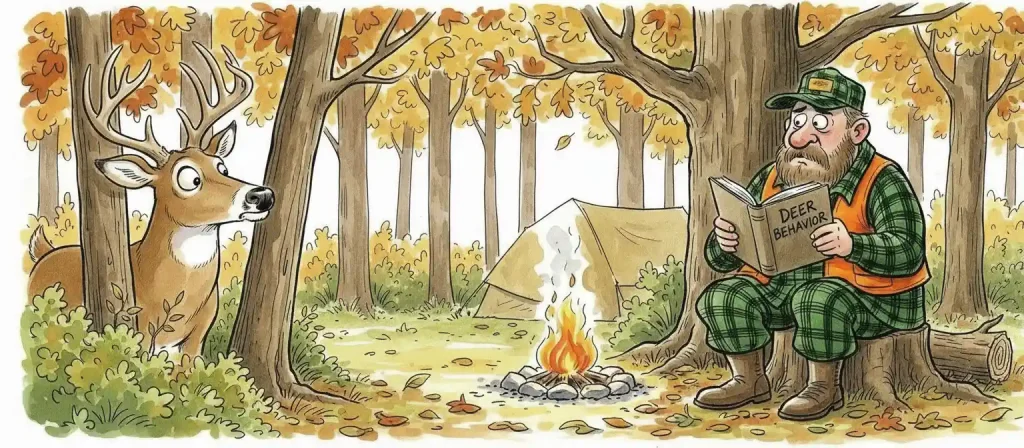
Whitetail Deer Behavior: How Understanding Deer Behavior Makes You a Better Hunter
Be A Deer to Hunt a Deer
Most inexperienced deer hunters become overly excited about the gear that they need for whitetail deer hunting. Gear like the best tree stands, scent elimination, camouflage clothing, and electronic deer calls are necessities in some instances but are not that crucial when hunting deer.
While it’s tempting to buy the latest deer hunting gadgets, it is often the understanding of deer behavior and how they move through the woods that leads to the most successful deer hunts. The movements of whitetail deer are guided by a set of innate behavioural patterns. The deer makes its movements based on four main factors: access to food sources, safety level, environmental challenges, and weather conditions.
I have learned after years of deer hunting that a lot of mistakes can be traced back to an incorrect interpretation of whitetail deer behavior. Like understanding the behavior of the people I interact with is helpful in understanding how they may react it is also the same when you understand whitetail deer behavior. Understanding whitetail deer behavior can help you understand how deer might react to certain situations, particularly the factors which cause deer to move in a particular manner.
The ability to recognize whitetail deer movement patterns enables hunters to develop successful hunting approaches. Here, I will examine the primary aspects of whitetail deer movement and provide you with information on how this knowledge can be applied in hunting situations.
The success of your deer hunting season will depend largely on the degree to which you are familiar with the deer’s pattern of behavior.
Understanding the Foundations of Whitetail Deer Behavior
Whitetail deer have developed their ability to survive through expert adaptation skills. At its most basic level, the daily activity of the whitetail deer revolves around trying to stay alive while meeting their basic needs. The way white-tailed deer prioritize these needs (food and water) can change due to the season and hunting pressure that may or may not be present.
The main factors which drive whitetail deer behavior include the need to breed, search for food, requirement for safety, and need to find shelter. Wild deer maintain a balance between feeding, avoiding danger, and making themselves available to the opposite sex.
Hunters can make their hunting season more successful by understanding how deer split their time between searching for food and protecting themselves from danger.
Deer are naturally most active during dawn and dusk. Generally, movement during daylight hours is most likely a response to a perceived security threat, whether it’s another animal, a person, or even the movement of people or other animals in the area. In particular, mature bucks tend to move when they feel secure, with much of their movement occurring under the cover of darkness or in thick cover.
Generally, hunting tends to be methodical. The practice of deer hunting requires hunters to follow particular methods. You are looking for predictable movements based on the predictable needs of the game.
Whitetail Deer Movement Patterns and Daily Behavior
There is considerable misunderstanding about the migratory habits of white-tailed deer. It is commonly thought by hunters that deer roam at random until they find a food source or come across some hazard. However, they live their lives according to strict daily routines.
While white-tailed deer occupy home ranges, these areas include essential habitat features such as bedding, food sources, and movement corridors. Movement to cover is often made along natural or visual cover lines, like the course of a river or a road, providing security.
When hunting, I try to be on the leeward side of a ridge since this area has a more gentle breeze. My attention shifts to two different areas: woodland with dense tree growth and adjacent fields that touch each other.
The way deer move through their environment depends on the time of day. The main reason for morning movement occurs because deer return to their bedding areas after feeding time. In the evening, deer get up from their beds and move toward their feeding areas.
During the rut, deer become active but tend to move short distances while staying near bedding and feeding areas.
The hardest deer behavior for many hunters to grasp is that of the adult buck. Many older bucks survive by exercising caution. They rely heavily on their sense of smell when choosing bedding sites and tend to move differently than younger deer.
Throughout the year, mature bucks are typically found near a dependable food source and some kind of bedding area. Deer will often bed with the wind behind them, while having a view down slope or downwind.
Success in setting up close to bedding during this time can be achieved, but it relies on perfect access and very little wind.
The rut season triggers deer to completely change their behavior and movement patterns, resulting in a complete rearrangement of their habitat space. When the breeding process peaks, bucks start to move around more often.
Despite the mating process, a buck’s primary concern is his safety. They often travel downwind of doe bedding areas, checking the area with their sense of smell without exposing themselves by using the lay of the land and available cover.
In the late season, variations in deer behavior occur once more. In such instances, deer may be drawn to areas with both food and shelter, typically food sources with vegetation that offers good concealment.
Movement of deer can increase when a cold front moves in, but can also be halted by hunting pressure.
A common misconception hunters have: they assume that the rules they’ve learned apply at any time of the year. The behavior of deer depends on the time of year. Your strategy needs to adapt to succeed during different parts of the deer hunting season.
Common Mistakes Hunters Make When Reading Deer Behavior
Disputes over whitetail deer behavior have often caused frustration for many individuals. Overhunting prime spots is a common problem. Mature deer are particularly sensitive to pressure, especially bucks. They stop daytime activities due to increasing pressure or will shift the area they spend most of their time in.
Hunters sometimes forget how wind and thermal conditions might affect their hunting plans. Many animals depend heavily on their sense of smell—this is particularly evident in deer. Their sense of smell is much more developed than any of their other senses. Don’t forget the importance of wind and thermals.
Using a stand with the wrong wind teaches a white-tailed deer your patterns and possibly the location of your hunting stand. If a deer perceives you as a threat, it may inform other deer in the area, reducing the likelihood of sightings. I’ve been busted before by a noisy doe who snorts and snorts and lets the whole deer woods know that I’m there.😒
Signs of recent use of a track or rub do not necessarily indicate the animal was active during the day. Remember that most deer movement is during the nighttime.
Rather than imposing your hunting plans on the deer’s habits, begin by slowing your pace and studying the patterns of deer movement. Let their actions inform how you proceed.
Practical Whitetail Deer Hunting Tips Based on Behavior
Using behavioral principles effectively can lead to positive hunting outcomes.
A spot near a spring that has some security cover might be a place a deer might hang out in, especially during the warmer part of the season. Likewise, during the colder parts of the hunting season, I’ve spotted numerous deer using a south-facing slope to catch some warmth no doubt and to do some browsing as well.
Areas where food, shelter, and water appear is a great place to start looking for deer sign. Being a buck hunter myself, I usually won’t hunt an area unless I see some signs of rubbing (buck rubs).
Approach every whitetail deer hunt with the aim of learning something new. A part of deer hunting is gathering information. The more you are out in the woods, the better hunter you will become. It’s just like anything else: the more you put in to it, the more you will get out of it.
Frequently Asked Questions About Whitetail Deer Behavior
Conclusion
If you want to be successful as a whitetail deer hunter you need to learn about their typical behaviors. When hunting white-tailed deer, I allow the deer’s daily routine to guide my strategy. Learning about deer survival methods that use cover, wind, food, and terrain has shown me that the you can pattern deer and put the odds in your favor of tagging out, but there is never a guarantee.
Your success depends on your drive and ability to stay out and hunt in the deer woods, not the quality of your equipment. Observe the deer closely, scouting their patterns and adapting your tactics to fit with what you observe. Applying this knowledge in the field will lead to more successful hunting and consistent outcomes.
Understanding whitetail deer behavior is crucial for effective hunting. By studying their habits and adapting strategies accordingly, hunters can significantly improve their chances of a successful hunting season.