
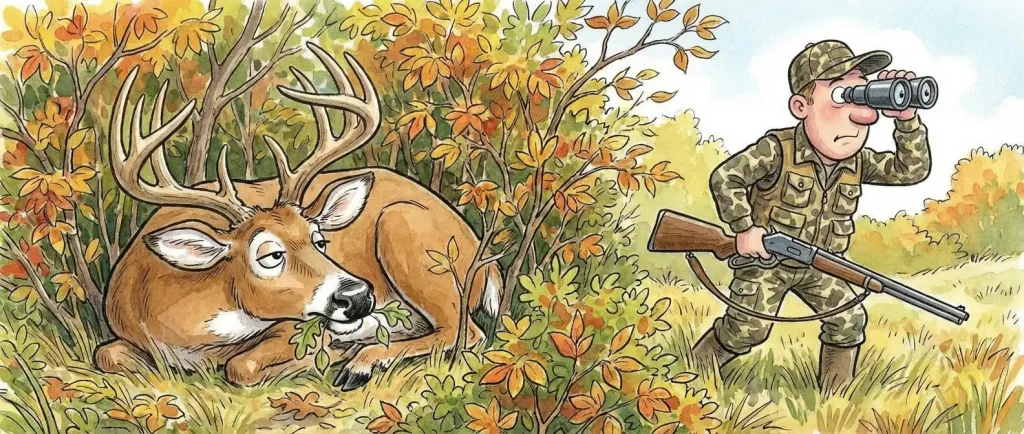
How to Find Whitetail Buck Bedding Areas (Without Blowing Them Out)
The Problem: Why Mature Bucks Feel Invisible
Experienced whitetail hunters have likely encountered this situation which involves numerous deer observations and abundant deer tracks yet the desired mature bucks become impossible to find during daylight hours.
The main reason for this frustration stems from the fact that hunters fail to understand the concept of buck bedding.
Mature whitetail bucks don’t bed like does. The bed arrangement follows a particular arrangement. The animals select resting spots which offer them feelings of security. Your ability to find food and trails becomes incomplete when you fail to observe where bucks bed. Finding whitetail buck bedding areas can be a bit of a challenge.
The Opportunity: Hunt Where Bucks Spend Their Daylight Hours
The discovery of buck behavior patterns regarding their bedding choices brought a complete transformation to my understanding. I could use my knowledge to determine the exact daylight locations where a mature buck would need to feel safe and secure – his bedding area.
Understanding buck bedding allows you to:
- Hunt him just before he gets to his bedding area (early mornings usually) or just as he gets up to feed (early evenings, around dusk usually).
- Slowly turn up the pressure later in the season if not seeing him earlier on. Get closer to his bedding area maybe.
- Formulate a plan to ambush him going to and coming from his bedding area.
- Figure out where he might be going to feed.
- Figure out what other deer might be bedding in the area – maybe doe bedding groups?
The Solution: How I Find Whitetail Buck Bedding Areas
How Bucks Choose Their Beds
A mature buck needs to select three essential locations for his bedding area.
- Security cover
- Wind advantage
- Visual awareness
Bucks want to smell danger before they see it and see danger before it reaches them.
Terrain Features I Focus On First
I begin my scouting process by looking for areas which provide natural advantages to deer for better survival.
- The leeward side of a ridge or mountain can serve as thermal and wind convergence areas where these elements meet.
- The highest point of a hill or mountain – should be located just below the summit rather than at the summit itself.
- Thick timber areas, or swampland (marsh or swamp islands).
- Conservation Reserve Program (CRP) zones.
And these locations allow bucks to bed with the wind at their back and danger in front of them — a classic mature buck setup.
What a Buck Bed Actually Looks Like
The appearance of a buck bed becomes obvious to people who understand its characteristics. I’m searching for:
The area contains one oval depression which differs from doe bedding because it appears as a single depression instead of multiple clusters. Also, look for hair in the bed. This bed should also be slightly larger than a doe bed.
The presence of large multiple single beds in the same location indicates to me that the buck uses this area during different wind conditions. Also, observe the size of deer tracks in the area of the bed.
Wind Direction Is the Key That Unlocks Bedding
Most hunters fail at this point.
Bucks select their bedding area based on their preference for particular wind directions. Bucks will also circle downwind of their bedding area before they feel secure approaching it.
Aggressive vs Conservative Tactics (When to Push, When to Back Off)
The “invasive” mindset can emerge. But it’s important to remain patient when trying to come up with a tactic that takes you close to a whitetail buck bedding area. If you remember anything, remember this:
You get one sit. You get one opportunity. Bucks tolerate zero pressure in their bedrooms.
I’ve had success a couple of different times hunting just outside of a buck’s bedding area and those times were early in the morning, and both times the bucks were browsing near their bedding areas before I shot them. You can hunt them close to a bedding area in the evening as well, but at anytime when hunting a whitetail buck bedding area you have to be very quiet and very mindful of the wind.
Why Deer Don’t Always Sleep Where You Expect
Deer don’t always bed in dense vegetation. But, they will bed down where they think they have some kind of advantage which might be:
- Where they can see long distances
- Thermal and wind advantage
- An escape route
Whether that whitetail buck bedding area is on a hillside, a ridge, a swamp or a field – you can bet they will have some kind of advantage on you. Proceed with caution.
Common Mistakes I See Hunters Make
Don’t make these mistakes when hunting a whitetail buck bedding area:
- Treating a buck bedding area as if it were a doe bedding area.
- Over-pressuring known buck bedding locations
- Ignoring wind and thermals
- Ignoring terrain
Your chances of success will significantly increase when you keep from making the above mistakes.
Practical Whitetail Deer Hunting Tips You Can Use Immediately
- Scout bedding in late winter and early spring
- Determine your entry and exit routes towards a buck bedding area before you begin installing your stand
- Don’t pressure bucks too much during the season – especially when it comes to their bedding areas.
Frequently Asked Questions About Whitetail Buck Bedding
Conclusion: Hunt Beds, Not Hopes
Learning about mature buck behavior has shown me that knowledge about their bedding areas stands as my most important concern and I’m still learning all about whitetail buck bedding areas. Food sources change. Patterns shift. Just remember that hunting pressure can move deer around, and during hunting season deer will generally find a nice thick area to hide in. In late season, they do seem to bed closer to the food sources.
Learning to read terrain and understanding wind patterns will help you understand the woods and how to hunt deer. I hope these whitetail deer hunting tips help users transform their hunting frustration into hunting assurance which leads to successful tag harvesting.
If you want to consistently kill mature bucks, start hunting close to where they sleep — just do it smart.