
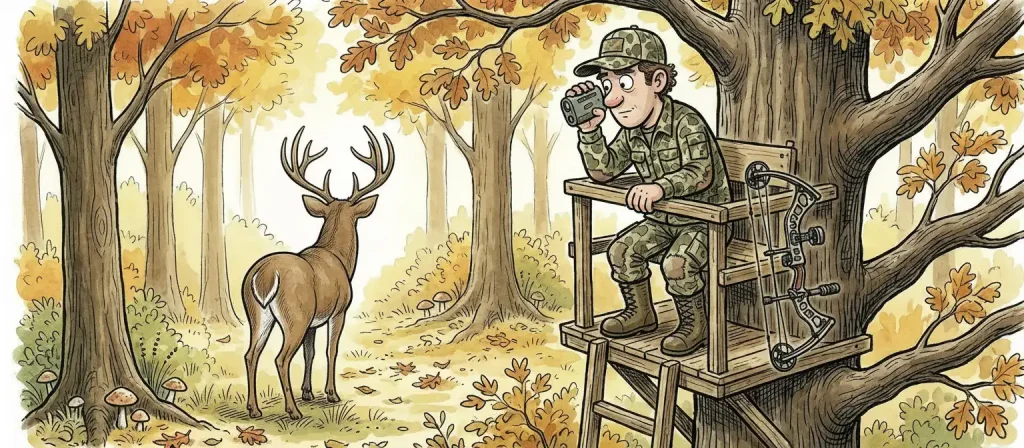
Using a Rangefinder for Whitetail Deer Hunting
Practicing with marked ranges is a great idea. When it comes to actual hunting, however, the deer are in the shadows, on the slopes, amidst the brush, etc. This makes the actual distance to the white deer in question look considerably different than the 30 yards or so that you perceive it to be. What you perceive to be 200 yards or so could actually be a considerable distance further.
In deer hunting rangefinders you want to read fast distances to deer-sized objects and display information relevant to deer hunting. For example, you want to read repeatedly the same distance to one object (e.g. a deer) and display the adjusted distance (so-called angle compensation) for the steep-terrain shots. In addition to the distance you want to read a precise aiming point (e.g. crosshairs) to be able to aim with your rangefinder at the deer instead of at the surrounding brush.
For me, the most important feature of a deer hunting rangefinder is to give you the exact distance to a deer. This will help you in your decision making as to whether you should take a shot at the deer or not. This will also confirm a shot and see if the deer is within your practiced limit or beyond it.
1. Picking a Rangefinder for Whitetail Deer Hunting – One That Works in Real Deer Country
Don’t get sucked in by those advertised “maximum distance” numbers—they’re usually based on shiny, reflective targets, not actual deer. What matters is consistent readings on deer-sized animals past your max shooting range.
Here’s what makes a difference for me:
– Quick, dependable readings—take a few measurements and they should all match.
– Angle compensation—especially helpful for treestands and steep hills, so you get the real, “shoot-for” distance.
– A focused aiming point—tight beam that targets the deer instead of getting lost in brush.
– Numbers you can read—bright sun, dark woods, doesn’t matter, the display stays visible.
– Simple controls—needs to work easily with one hand, even wearing gloves.
– Weatherproof—rain, snow, cold, mud, bring it on.
– Scanning and priority modes—scan keeps reading while the deer moves; brush mode helps get past foreground clutter.
Most rangefinders show 5x or 6x magnification—it helps you aim, but honestly, it’s no substitute for binoculars. I always spot and identify what I’m shooting first, then pull out the rangefinder.
Complicated menus might sound cool, but I’d take an easy-to-use unit any day. Test it out: can it actually read a deer-sized target past your ethical range? That’s what counts—not what the box claims.
2. Use It Differently for Bow or Rifle Hunting
If you bowhunt, you need quick and precise readings. Arrows drop fast, so even being off by a couple yards can mean the shot goes wrong. When I’m in a treestand, I use the angle-adjusted distance the rangefinder suggests—that’s the number for my setup. But it’s important to know both the real line-of-sight and the “shoot-for” numbers.
Before deer ever show up, I’ll range trails, tree edges, landmarks: maybe that near trail’s 18 yards, the big oak’s 27, and the clearing’s 36. Now I know them without moving. Scan mode lets me keep tracking a walking deer.
Rifle hunting is a little different. You’ll probably need to measure longer distances and match them up to your drop chart, reticle hold, or ballistic app. But just because the rangefinder says you can reach, you have to check wind, steadiness, visibility, and your own proven skill before ever squeezing the trigger.
When stalking, I range the deer and also check landmarks—ridges, trees, anything that might help me close the distance. Either way, pay attention to whether your rangefinder shows line-of-sight or “shoot-for” distances. Mixing them up defeats the whole point.
3. Practice Before Deer Season—Make It Automatic
I practice until using the rangefinder feels natural—almost instinct. First at easy, known distances, then at tough targets: small, dark, in brush, and weird angles. Numbers should line up every time.
I check whether the laser matches up with the reticle—aim at a small target with something farther behind it. Move the reticle just off the target, see where readings change. If the beam’s off, learn where it actually reads.
In the field, I stabilize against a tree, rail, my pack—anything. If there’s time, I measure twice and use nearby landmarks to confirm. Weather, fog, reflective surfaces, dying batteries—any of them can throw off readings.
Electronics quit sometimes, so I always estimate the distance first, then use the rangefinder to check myself. It sharpens my eye and catches obvious mistakes.
Common Mistakes
– Trusting max distance: Forget the shiny-object range—focus on deer range.
– Accidentally ranging brush: Grass and twigs return shorter distances than the deer.
– Getting confused about modes: Know whether you’re seeing line-of-sight or angle-adjusted numbers.
– Waiting too long: Pre-range likely spots before the deer ever shows.
– Ignoring your battery: Start with a fresh one and always pack a dry spare.
– Skipping real practice: Test in bad light, rough weather, steep angles, and with gloves on.
– Pushing your limits: Knowing yardage doesn’t fix shaky aim, unsafe shots, or inexperience.
Practical Tips & Takeaways
Every hunt, I keep the rangefinder in the same spot—easy to reach. Before heading out, I clean the lenses, double-check the mode and brightness, and make sure the battery’s solid. In the stand, I range some permanent landmarks.
I keep it leashed with a quiet tether so it never hits the ground during a hurry-up moment.
I practice moving from binoculars to rangefinder to gun position, always careful not to point at anything except what’s confirmed. I test scan and brush modes before the season starts.
The best rangefinder is the one that gives reliable readings on the deer and terrain you hunt—fast enough so you don’t miss your shot.
Here’s another article you might find helpful on choosing the right rangefinder for deer hunting.
FAQ About Rangefinders for Deer Hunting
Final Thoughts
A rangefinder tells you one thing: how far. That’s enough to pick your aim point, plan your stalk, or realize the deer is too far for you to shoot ethically.
Buy for reliable performance on deer, make sure you understand all the display and angle modes, and practice until it’s second nature. One of the best whitetail deer hunting tips? – Get rid of the guesswork before you ever draw the shot.