
How to Hunt the Wind: Advanced Whitetail Deer Hunting Tips for Outsmarting Mature Bucks
The Wind – The Biggest Challenge
The wind stands as my biggest whitetail hunting challenge because it consistently ruins my hunting plans. My camouflage setup and stand placement and mock scrapes and rattling sequence become useless when the wind reveals my position to the deer.
A buck’s sense of smell remains his most reliable sense which makes it impossible to deceive him. The sense of smell of experienced bucks proves unbeatable because they have learned to survive through multiple years of facing hunters and predators and natural selection. The older bucks of the forest base their survival on wind patterns because they avoid taking any risks. The wind serves as their main protective mechanism which requires hunters to develop equal wind-hunting abilities to succeed in deer hunting.
The following article presents advanced whitetail deer hunting techniques which explain how to use wind as a hunting tool at the same level as mature bucks do. My thirty years of whitetail hunting experience in the Pacific Northwest has led me to develop this comprehensive guide which explains how wind interacts with thermals and terrain and deer behavior to help hunters master the essential whitetail deer hunting technique of using the wind to your advantage when hunting.
The Wind Creates More Problems for Hunters Than They Understand
Most hunters view wind direction through a basic compass system which shows:
- Deer approach hunter while wind blows from their direction = good
- Deer approach hunter while wind blows from his direction = bad
The basic principle of wind direction works in theory but real-world conditions create complex patterns because terrain shapes wind paths and vegetation disrupts it and hollows create swirling air and thermals work against it. The key to successful hunting involves using the wind to approach your target from the front.
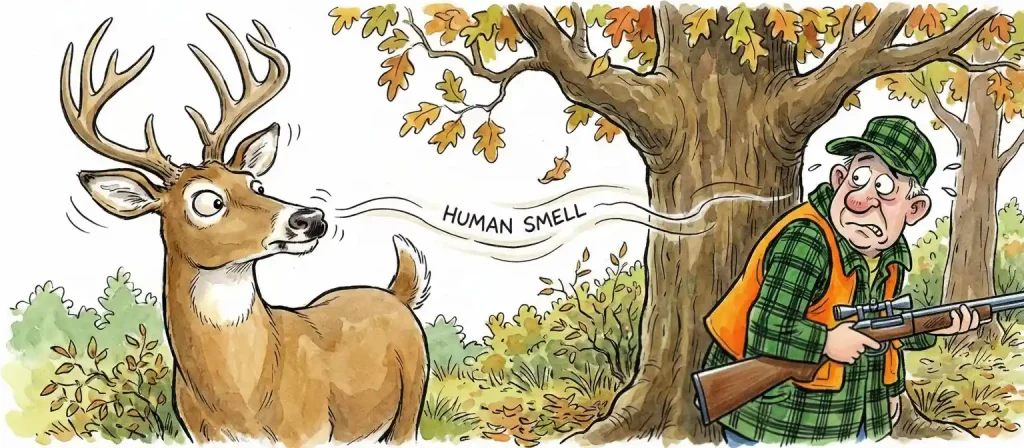
A buck depends on his unpredictable movements to survive in the wild. When a buck detects any human scent he will stop all his daytime activities and leave through the back door without being seen by hunters who remain empty-handed in the timber.
Mature bucks employ the wind as an intentional tool for their survival. Hunters who learn to control wind patterns will find and kill larger deer species.
Mature Bucks Utilize the Wind for Three Specific Reasons
Learning to hunt the wind effectively requires knowledge about how deer use wind patterns in their environment. The sense of smell functions as the primary survival tool for mature whitetail deer which they use in the same way pilots use their instruments. The wind serves three essential functions for mature whitetail deer.
1. Detecting Danger
A mature buck depends on his sense of smell more than any other sense. Before entering an open area or starting his transition from resting to feeding he will check the wind direction. Any unusual smell will make him stay in his current position.
2. Scent-Checking Does
During the rutting season bucks will move against the wind or follow the wind to detect scents from doe resting areas at long distances. The buck uses wind patterns to detect scents before entering bedding areas.
3. Investigating Calls and Lures
When you perform a grunt or rattle or use scents a mature buck will perform a downwind circle before making any decision. Many hunters fail to see their called-in deer because the animal detects their scent before revealing itself. Just be aware of what’s downwind of you when calling or rattling. I’ve heard bucks snort at me from downwind because they scented me and then wouldn’t come out of the thick brush or treeline, but they would keep making a racket while never exposing themselves. It’s hard to watch your downwind when hunting thick areas.
The ability to understand deer behavior patterns enables hunters to use wind as their hunting tool instead of facing it as an obstacle when pursuing mature bucks.
The Hidden Forces That Control Scent: Wind, Terrain, and Thermals
Most hunters check wind direction but they fail to recognize the hidden elements which affect how scents move through the air. The behavior of wind follows water patterns because it moves in waves while it rises and falls based on temperature changes and terrain shapes. So, basically wind flows like water at times.
Let’s break this down.—
Wind Direction: The Starting Point, Not the Final Answer
You need to understand basic wind direction patterns. The natural wind patterns get distorted by your location and the height of your position and the surrounding landscape features.
Ridges produce wind turbulence that causes air to change direction. The wind creates spinning air pockets inside hollow areas. The wind pattern through dense vegetation produces similar patterns to stream eddies. The wind speed increases when air moves down open slopes than what would be expected.
A mature buck will detect your scent before he hears any twig snap when your scent enters these unpredictable wind patterns.
Thermals: The Invisible Current Most Hunters Ignore
The movement of air through the atmosphere produces thermal currents which form because of temperature variations.
The sun’s heat causes air and scent to rise through the air during the first part of the day. The air movement pattern reverses during evening hours because temperatures decrease.
The wind patterns change throughout the day because of thermal movements. The morning wind that seems favorable will turn into an unfavorable condition later in the morning because thermal currents will lift your scent toward deer habitats. The evening wind conditions can become unfavorable if you are hunting up high in the evening.
Most hunters fail to recognize thermals as a vital factor which leads to their biggest mistake during hunting trips. The basic rule for hunting requires you to climb higher during morning hours and descend to lower elevations during evening hours. I avoid approaching areas that exist above me during evening hunts until the last part of daylight.
Terrain: The Silent Sculptor of Airflow
The way whitetail deer react to wind patterns depends on their surroundings.
During windy conditions deer choose to find protection in specific locations.
The leeward side of ridges provides protection from wind while thick cover and creek bottoms and protected timber areas create secure spaces for deer to rest. These areas provide stable scent conditions and improved hearing which makes them perfect for mature buck bedding and travel activities.
How to Hunt the Wind Like a Mature Buck: Proven Strategies
The following strategies have been developed through my personal experience and information obtained from various sources including videos and books and articles.
1. Hunt Crosswind, Not Straight Downwind
Most hunters attempt to position themselves so the wind blows directly from the deer to their location. The main issue with this approach is that bucks tend to avoid traveling directly into wind currents. Bucks choose to move across the wind because this allows them to check wide areas through scenting as they walk.
Your crosswind position enables you to block deer paths without creating a direct downwind exposure to their travel routes.
2. Position Stands Based on Terrain and Thermals
The setup of your stand depends on the current time and temperature and sun position and elevation height.
The rising thermal currents during morning hours will lift your scent toward higher elevations. The descending thermal currents during evening hours will push your scent toward lower elevations.
A stand which performs well during sunrise becomes ineffective during the middle part of the day.
3. Use Natural Obstacles to Control Downwind Circling
A mature buck will attempt to approach your location by moving downwind when you use calling or rattling or scents. The behavior of coyotes during hunting sessions shows that they will attempt to circle downwind before making an approach to the calling area – deer exhibit similar behavior. The natural barriers in your environment should guide your stand placement.
The combination of steep banks and creeks and thick brush and fencelines creates barriers that restrict deer from performing complete downwind circles which leads to better shooting opportunities.
4. Hunt Wind-Sheltered Areas on Windy Days
The strong winds do not stop whitetail deer from continuing their movements because they find alternative routes. The knowledge about whitetail behavior during windy conditions comes from my personal experience and from Jeff at Whitetail Habitat Solutions. The YouTube channel of Whitetail Habitat Solutions contains excellent content.
The best locations for hunting during windy conditions include leeward ridges and timber pockets and swamps and thickets.
5. Have Multiple Stands for Different Wind Conditions
A single stand position will not work for all wind directions.
Every experienced hunter needs to establish multiple stands which cover different wind directions.
Stands for north-based winds and south-based winds should be part of every hunter’s strategy. As far as thermals go, some stands are better morning stands while some stands are better evening stands.
Multiple stands enable you to shift your position rapidly when wind patterns shift. The number of stands you have determines your hunting strategy based on wind and thermal conditions.
6. Maintain Strong Scent Control
Knowledge of wind patterns and thermal movements becomes useless when you fail to control your scent.
The following scent management practices form the foundation of essential scent habits.
- Scent-free detergent should be used for washing clothing.
- Rubber boots serve as a scent-control measure.
- Stay away from vegetation during your entry into the area.
- Use scent-neutral soap for personal hygiene.
- Be careful where and how you store your clothing and equipment as well. Don’t let your dog nap on your hunting clothes the night before you go out to hunt. 😃
Your wind strategy benefits from scent control which helps you handle small wind changes better.
A Real-World Wind Lesson From My Own Hunt
I established my position on a ridge that overlooked a bedding area that was directly across from me. While the wind seemed to move directly from the bedding area down toward the a feeding area that was just below, the wind suddenly change with just a brief crosswind that blew my scent right towards the bedding area across from me.
So, I wasn’t expecting that crosswind that ruined my hunt.
The sun’s descent did start to carry my scent down the hill, which I had planned on, but the gig was already up. The thermals worked for the most part, but the crosswind didn’t help me, and I certainly didn’t plan on it showing up.
Anyway, the deer detected my scent stream before I could see them and they disappeared from view. The deer detected my presence before I became aware of their presence.
The knowledge of wind patterns will definitely help you in your hunting, so plan on using wind and thermals to your advantage – just remember that sometimes things change in the deer woods.🙂
Frequently Asked Questions About Hunting the Wind
Conclusion: The Wind Is Your Most Powerful Tool
The wind stands as one of your most important factors for successful mature buck hunting.
Your ability to succeed in whitetail deer hunting depends on your understanding of five essential elements which include wind direction, thermals, terrain effects, buck scent-checking behavior and scent control.
The knowledge of wind patterns allows you to outsmart most other hunters.
Mature bucks survive because they use their noses and wind patterns to their advantage. Your hunting success depends on your ability to understand wind patterns better than the deer do.
The wind becomes your hunting tool when you learn to use it effectively. Purposeful hunting requires you to understand the wind patterns. The knowledge of wind patterns will help you transform invisible air movements into your best hunting advantage in the woods.